Monday, August 30, 2010

Hop analysis: alpha and beta acids

First of all I want to thank all of you who visit this blog. More than 1000 visits! And of course a special thanks to my follower (you know who you are!), the repeated visitors and my 4 fans on facebook. I'm glad so many beer geeks have found the way to my blog. Now to the subject of today.
We recently bought some hops from a wholesale retailer in Belgium to sell to the members of our homebrew club. Unfortunately the retailer is not the best communicator. First it took several months for him to send the order, then he didn't inform us about the alpha acid content of the hops. He didn't even reply to my mail. It looks like we have to find another retailer next time... Fortunately, I work in a research lab and have access to a spectrophotometer. So I did it myself!
The method for determining alpha and beta acids in hops I found here. As this might be interesting for some of you, I took some photos.
First I pulverized the pellets with a pestle in a mortar. Whole pellets are to dense and would never allow the acids to be extracted from the hops.

For extraction of the oil containing alpha and beta acids toluene is used. After some time looking I found it in a paint store where it is sold a a paint thinner.

After weighing in the hops, I added the toluene and extracted the oils for 30 minutes.

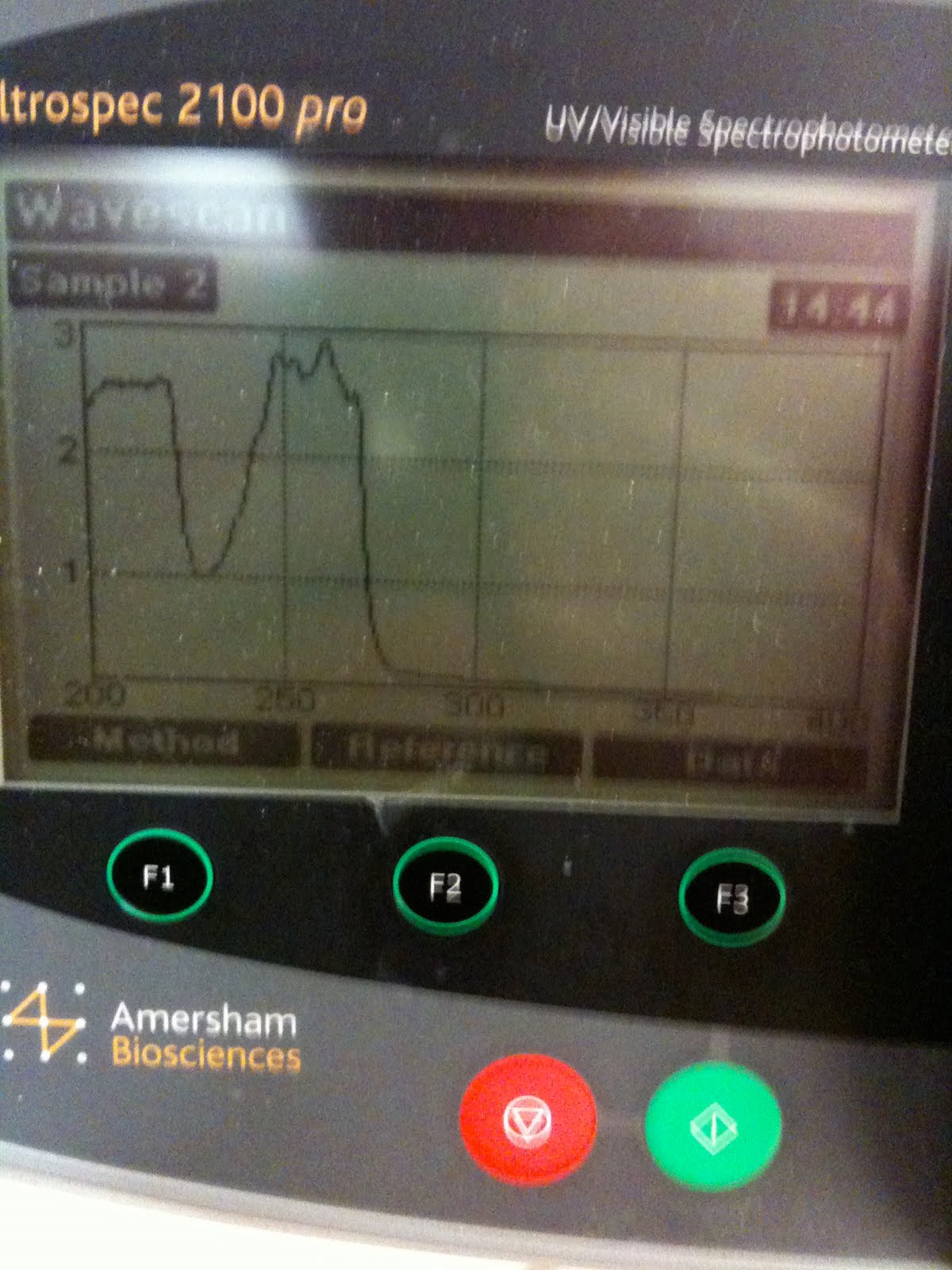
After diluting the samples and control i methanol I read the absorbances at 275 nm, 325nm and 375 nm. Because I wanted to get an idea of the background absorbance by the solvents, I also run a scan of the control. As you can see, down to 275 nm the background is rather low, but at lower wavelengths the absorbance quickly increases.

Finally I did the math and found the Saaz and Styrian goldings to have about 2% AA. The Magnum and Northern brewer about 11%. I guess I'll have to do a test brew to find out if it fits. One more reason to brew!

Monday, August 9, 2010

How my quadrupel turned into an oud bruin

This week I tasted a bottle of a quadrupel I brewed 2 months ago, and was surprised to discover a slight sourness. Not bad at all, it tasted a bit like Rodenbach, or Oerbier. However, it was not supposed to be there, which makes it an infection. I suppose this is what can happen if you brew during summer. I put a drop of the dregs under the microscope and found it to be a pediococcus infection. Luckily the taste is realy nice, so I won't pour it down the drain. Below a picture of the dregs:

Monday, July 19, 2010

The Brett of Cochonette

This spring I isolated yeast from Cochonette, an amber beer brewed by Brasserie à vapeur. I noticed, when drinking the beer, that there was something funky going on. Not surprisingly, because brasserie à vapeur is an artisanal brewery and their brewing technique is much lika it was 100 years ago. So, yeasterday I was refreshing my yeast bank and came across the vial of Cochonette yeast. I still wasn't sure what caused the funky sourness in the beer (lactic acid bacteria, brett?) so I decided to have a look under the microscope. I haven't been able to take pictures yet, but from the look of it, this beer was heavily "infected" with brettanomyces. Looks like I will have to isolate single colonies... Oh well, that just increases my yeast bank with one more strain: the Brett of Cochonette!

Edit 21/7: Picture!

The small round cells are Saccharomyces, the smaller and slimmer ones the Brett. As I said, more Brett then Saccharomyces...

Monday, July 12, 2010

Introducing project Hanssens

Now that I successfully hav isolated a Saccharomyces and a Brettanomyces strain from Orval, it is time to go wild. A few weeks ago, I drank a Hanssens oude geuze. I saved the dregs and poured some DME wort on to bow some life into this wild dormant soup. After a day, the dregs had come to life and were happily producing CO2. I will now plate out this mini starter and hope to get some nice colonies. By making a starter I should have favored the growth of Saccharomices strains, so theoretically thay should show up first on my plate. After a while I also hope to get some Brett strains appearing. I also would like to get som Pedio or Lactobacillus out. For that I will use DME agar supplemented with 10 % tomato juice, some dead yeast and 2% CaCO3 to buffer te acid produced. As a teaser, here's a picture of what my mini starter looks like under a microscope. The tiny rods are most likely Lacobacillus of Pediococcus. The bigger cells look like yeast, of which the round ones look like Saccharomyces and the smaller ones Brettanomyces. To be continued...

Thursday, July 8, 2010

Planning the next brewing season. Suggestions?

During the summer I will take it a bit easy. I will mainly be drinking instead of brewing. However, the recipe designer in me can't help thinking about hte next brewing season, again dominated by Belgian beer styles. Here's what I want to brew during the fall (if I manage):

  • Dubbel

  • Tripel

  • Strong golden ale

  • Lambic

  • Imperian amber wit

  • Blonde

  • 100% Brett amber ale (Brett from the Orval project

  • Strong saison with Sorachi Ace hops


The reason why I want to brew these beers is either because I brewed them before and want to improve the recipe, or because I feel the urge to experiment with hops and yeast strains. More then one of them will be split batches, with several yeasts in parallel. I really don't feel like washing 1000+ bottles, whitch is approximately what it will take to bottle all of these beers. Should I consider kegging? I don't know, in my opinion, nothing beats bottle conditioned beer!

Tuesday, July 6, 2010

Project Orval, the first pictures!

I have finally managed to take some pictures of some of my orval clones. On the left you can see one clone, probably Saccharomyces cerevisiae because of its rounded shape and budding daughter cell. On the right you see a clone with the working name "tiny colony" because it grew much slower on wort agar. Judging by its slow growth and its ogival shape, this is probably a brett strain. At least it's not Saccharomyces cerevisiae.

Wednesday, June 23, 2010

Today's brewing day!

Today I will brew my (probably) last beer before the summer. A Belgian dark strong ale called "St-Trudo Abdis 12" after a monastery in Male, close to Bruges (Belgium) where I grew up. I even have a personal connection with the monastery as my childhood dentist changed career and became a nun.
It should be a nice brew with a respectable OG of around 1100. A few experimental touches: first time I brew a massive beer on the club's Speidel Braumeister, and as part of my sugar I will use molasses. The exact amount will be determined later, as I want to taste the wort after several smaller amounts of molasses. I definately don't want to make a licorice bomb!
As the mashing is automated in the braumeister, I should have plenty of time to dish-wash 7 crates of empty bottles and bottle 3 beers :)