


Friday, November 26, 2010
Swedish brewing radio needs your support!
The Swedish brewing radio is a project run by two homebrewers who have invested a lot of time and money in this great service towards swedish homebrewers. As the traffic on the site has exceeded their wildest dreams, they now need your support to keep the project running. Interested? Have a look at bryggradio.com and click on the donation button! I did.

Tuesday, November 16, 2010
Fermenteezer, sorachi saison and tripel
It's been a while since my last post. The family keeps me busy these days, so finding time to blog is not always easy. However, I am writing now, and will start off by telling about my fermenteezer, or fermentation freezer.
I had been thinking about controlling my fermentation temperature for a while, but until I really knew what I wanted I used a 50 l bucket filled with water. In the water was a aquarium heating element to control the temperature, and my 30 l fermentation bucket was floating in the big bucket. Pretty good system, but it only allows heating. Worthless for cold crashing and lager brewing, or when the ambient temperature is too high. Finally, after reading through a lot of post on American, Dutch, Belgian and Swedish forums (being a polyglot has its advantages...) I knew what I wanted. For the fermentation chamber a wanted a box freezer. Fridges don't go low enough (how else am I going to lager my Duvel clone, if I can't reach -3 °C?), and upright freezers don't fit a bucket. The box freezer I bought is rather small (the car also has to fit in the garage) and fits 1 30l bucket or 2 25 liter water containers.
For controlling the temperature I wanted to use a thermostat that can steer both cooling and heating. I also wanted to control the temperature accurately. The TC-10 from Forttex fulfilled all of these criteria. For heating I used a hair dryer. Luckily the cheapest I could find also had the lowest wattage. After all, I don’t want to grill my beer...
This is how it looks: a fermentation freezer steered by a TC-10.


The beer then... I have designed a few recipes, but unfortunately I haven't had time to brew them yet. As belgoträffen, a local competition for Belgian style beers, is approaching it was about time to get going. This is why I will brew not less then 2 beers this week. First I will brew a saison with sorachi ace hops, 20 liter on my own gear. Later this week I will brew the 2010 version of my tripel on the club's braumeister. 2 brews I'm really looking forward to. I am really curious about the sorachi hops. They are suppose to give a nice lemon zest/lemongrass aroma to the beer. I hope it will not be like biting in a lemon. To be on the safe side I'll use some styrian goldings too.
The tripel was the 2009 success story. I was quite proud of it myself, and it scored the highest of my beers on the Swedish championships. Taking the comments of the jury into consideration I will now slightly modify the recipe, control my fermentation temperature and brew enough for both belgoträffen and the Swedish championships. Also the yeast is slightly different, Instead of wyeast 3787 I will now use a starter from a single colony of Westmalle yeast, directly from the source.
Will I brew a price beast? Not sure... but as long as I like it, I'll find people willing to help me emptying the keg.
I had been thinking about controlling my fermentation temperature for a while, but until I really knew what I wanted I used a 50 l bucket filled with water. In the water was a aquarium heating element to control the temperature, and my 30 l fermentation bucket was floating in the big bucket. Pretty good system, but it only allows heating. Worthless for cold crashing and lager brewing, or when the ambient temperature is too high. Finally, after reading through a lot of post on American, Dutch, Belgian and Swedish forums (being a polyglot has its advantages...) I knew what I wanted. For the fermentation chamber a wanted a box freezer. Fridges don't go low enough (how else am I going to lager my Duvel clone, if I can't reach -3 °C?), and upright freezers don't fit a bucket. The box freezer I bought is rather small (the car also has to fit in the garage) and fits 1 30l bucket or 2 25 liter water containers.
For controlling the temperature I wanted to use a thermostat that can steer both cooling and heating. I also wanted to control the temperature accurately. The TC-10 from Forttex fulfilled all of these criteria. For heating I used a hair dryer. Luckily the cheapest I could find also had the lowest wattage. After all, I don’t want to grill my beer...
This is how it looks: a fermentation freezer steered by a TC-10.


The beer then... I have designed a few recipes, but unfortunately I haven't had time to brew them yet. As belgoträffen, a local competition for Belgian style beers, is approaching it was about time to get going. This is why I will brew not less then 2 beers this week. First I will brew a saison with sorachi ace hops, 20 liter on my own gear. Later this week I will brew the 2010 version of my tripel on the club's braumeister. 2 brews I'm really looking forward to. I am really curious about the sorachi hops. They are suppose to give a nice lemon zest/lemongrass aroma to the beer. I hope it will not be like biting in a lemon. To be on the safe side I'll use some styrian goldings too.
The tripel was the 2009 success story. I was quite proud of it myself, and it scored the highest of my beers on the Swedish championships. Taking the comments of the jury into consideration I will now slightly modify the recipe, control my fermentation temperature and brew enough for both belgoträffen and the Swedish championships. Also the yeast is slightly different, Instead of wyeast 3787 I will now use a starter from a single colony of Westmalle yeast, directly from the source.
Will I brew a price beast? Not sure... but as long as I like it, I'll find people willing to help me emptying the keg.
Saturday, October 16, 2010
Stirplate
I finally own a magnetic stirplate. It was about time. As I usually use yeast from my yeast bank, starters can get quite big without a stirplate.Take my last beer for example. Without a stirplate, I would need 3.5 l starter, with a stirplate 1.3. Not only are smaller starters easier, they are also cheaper, you need less malt extract. Commercial stirplates tend to be quite expensive, as they are made to stir big volumes on a daily base. For my purposes, I decided a home-made version would be good enough. So, I went to the local electronics store and bought a box, a 12V fan, a few rare earth magnets, a contact and a potentiometer. All together less then 250 Swedish kronor (25€, 35$). Maybe not as durable as a commercial stirplat, but it works. Here's the result stirring a 100 ml starter, but it's capable of stirring starters up to 1 liter.


Monday, August 30, 2010
Hop analysis: alpha and beta acids
First of all I want to thank all of you who visit this blog. More than 1000 visits! And of course a special thanks to my follower (you know who you are!), the repeated visitors and my 4 fans on facebook. I'm glad so many beer geeks have found the way to my blog. Now to the subject of today.
We recently bought some hops from a wholesale retailer in Belgium to sell to the members of our homebrew club. Unfortunately the retailer is not the best communicator. First it took several months for him to send the order, then he didn't inform us about the alpha acid content of the hops. He didn't even reply to my mail. It looks like we have to find another retailer next time... Fortunately, I work in a research lab and have access to a spectrophotometer. So I did it myself!
The method for determining alpha and beta acids in hops I found here. As this might be interesting for some of you, I took some photos.
First I pulverized the pellets with a pestle in a mortar. Whole pellets are to dense and would never allow the acids to be extracted from the hops.

For extraction of the oil containing alpha and beta acids toluene is used. After some time looking I found it in a paint store where it is sold a a paint thinner.

After weighing in the hops, I added the toluene and extracted the oils for 30 minutes.

After diluting the samples and control i methanol I read the absorbances at 275 nm, 325nm and 375 nm. Because I wanted to get an idea of the background absorbance by the solvents, I also run a scan of the control. As you can see, down to 275 nm the background is rather low, but at lower wavelengths the absorbance quickly increases.


Finally I did the math and found the Saaz and Styrian goldings to have about 2% AA. The Magnum and Northern brewer about 11%. I guess I'll have to do a test brew to find out if it fits. One more reason to brew!
We recently bought some hops from a wholesale retailer in Belgium to sell to the members of our homebrew club. Unfortunately the retailer is not the best communicator. First it took several months for him to send the order, then he didn't inform us about the alpha acid content of the hops. He didn't even reply to my mail. It looks like we have to find another retailer next time... Fortunately, I work in a research lab and have access to a spectrophotometer. So I did it myself!
The method for determining alpha and beta acids in hops I found here. As this might be interesting for some of you, I took some photos.
First I pulverized the pellets with a pestle in a mortar. Whole pellets are to dense and would never allow the acids to be extracted from the hops.

For extraction of the oil containing alpha and beta acids toluene is used. After some time looking I found it in a paint store where it is sold a a paint thinner.

After weighing in the hops, I added the toluene and extracted the oils for 30 minutes.

After diluting the samples and control i methanol I read the absorbances at 275 nm, 325nm and 375 nm. Because I wanted to get an idea of the background absorbance by the solvents, I also run a scan of the control. As you can see, down to 275 nm the background is rather low, but at lower wavelengths the absorbance quickly increases.

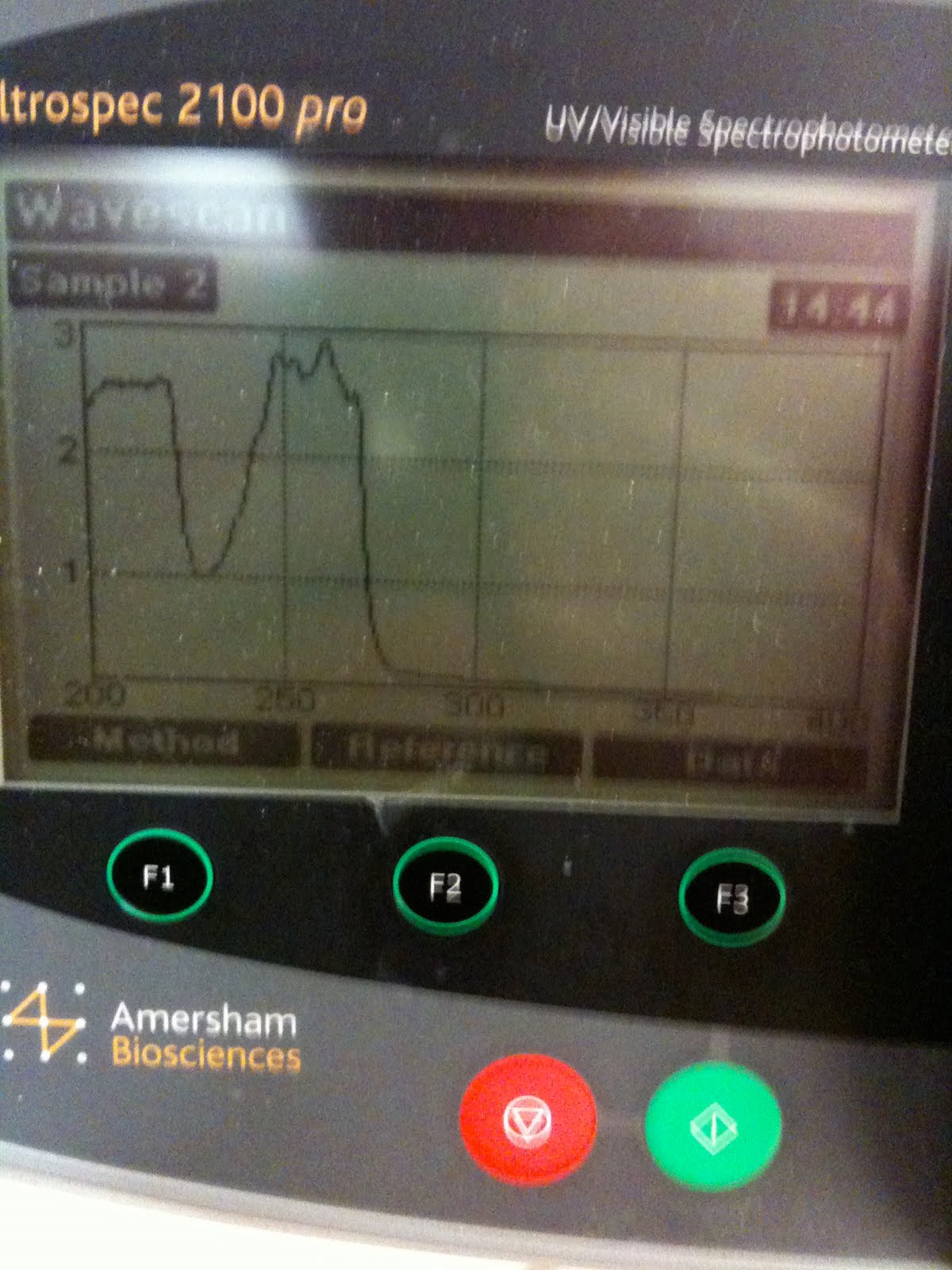
Finally I did the math and found the Saaz and Styrian goldings to have about 2% AA. The Magnum and Northern brewer about 11%. I guess I'll have to do a test brew to find out if it fits. One more reason to brew!
Monday, August 9, 2010
How my quadrupel turned into an oud bruin
This week I tasted a bottle of a quadrupel I brewed 2 months ago, and was surprised to discover a slight sourness. Not bad at all, it tasted a bit like Rodenbach, or Oerbier. However, it was not supposed to be there, which makes it an infection. I suppose this is what can happen if you brew during summer. I put a drop of the dregs under the microscope and found it to be a pediococcus infection. Luckily the taste is realy nice, so I won't pour it down the drain. Below a picture of the dregs:

Monday, July 19, 2010
The Brett of Cochonette
This spring I isolated yeast from Cochonette, an amber beer brewed by Brasserie à vapeur. I noticed, when drinking the beer, that there was something funky going on. Not surprisingly, because brasserie à vapeur is an artisanal brewery and their brewing technique is much lika it was 100 years ago. So, yeasterday I was refreshing my yeast bank and came across the vial of Cochonette yeast. I still wasn't sure what caused the funky sourness in the beer (lactic acid bacteria, brett?) so I decided to have a look under the microscope. I haven't been able to take pictures yet, but from the look of it, this beer was heavily "infected" with brettanomyces. Looks like I will have to isolate single colonies... Oh well, that just increases my yeast bank with one more strain: the Brett of Cochonette!
Edit 21/7: Picture!

The small round cells are Saccharomyces, the smaller and slimmer ones the Brett. As I said, more Brett then Saccharomyces...
Edit 21/7: Picture!

The small round cells are Saccharomyces, the smaller and slimmer ones the Brett. As I said, more Brett then Saccharomyces...
Monday, July 12, 2010
Introducing project Hanssens
Now that I successfully hav isolated a Saccharomyces and a Brettanomyces strain from Orval, it is time to go wild. A few weeks ago, I drank a Hanssens oude geuze. I saved the dregs and poured some DME wort on to bow some life into this wild dormant soup. After a day, the dregs had come to life and were happily producing CO2. I will now plate out this mini starter and hope to get some nice colonies. By making a starter I should have favored the growth of Saccharomices strains, so theoretically thay should show up first on my plate. After a while I also hope to get some Brett strains appearing. I also would like to get som Pedio or Lactobacillus out. For that I will use DME agar supplemented with 10 % tomato juice, some dead yeast and 2% CaCO3 to buffer te acid produced. As a teaser, here's a picture of what my mini starter looks like under a microscope. The tiny rods are most likely Lacobacillus of Pediococcus. The bigger cells look like yeast, of which the round ones look like Saccharomyces and the smaller ones Brettanomyces. To be continued...


Subscribe to:
Posts (Atom)